Loading…
Loading…
Explore agent harness engineering, the next evolution of prompt and context engineering for AI models like Claude, integrating personalization, context, actions, memory, and delegation.
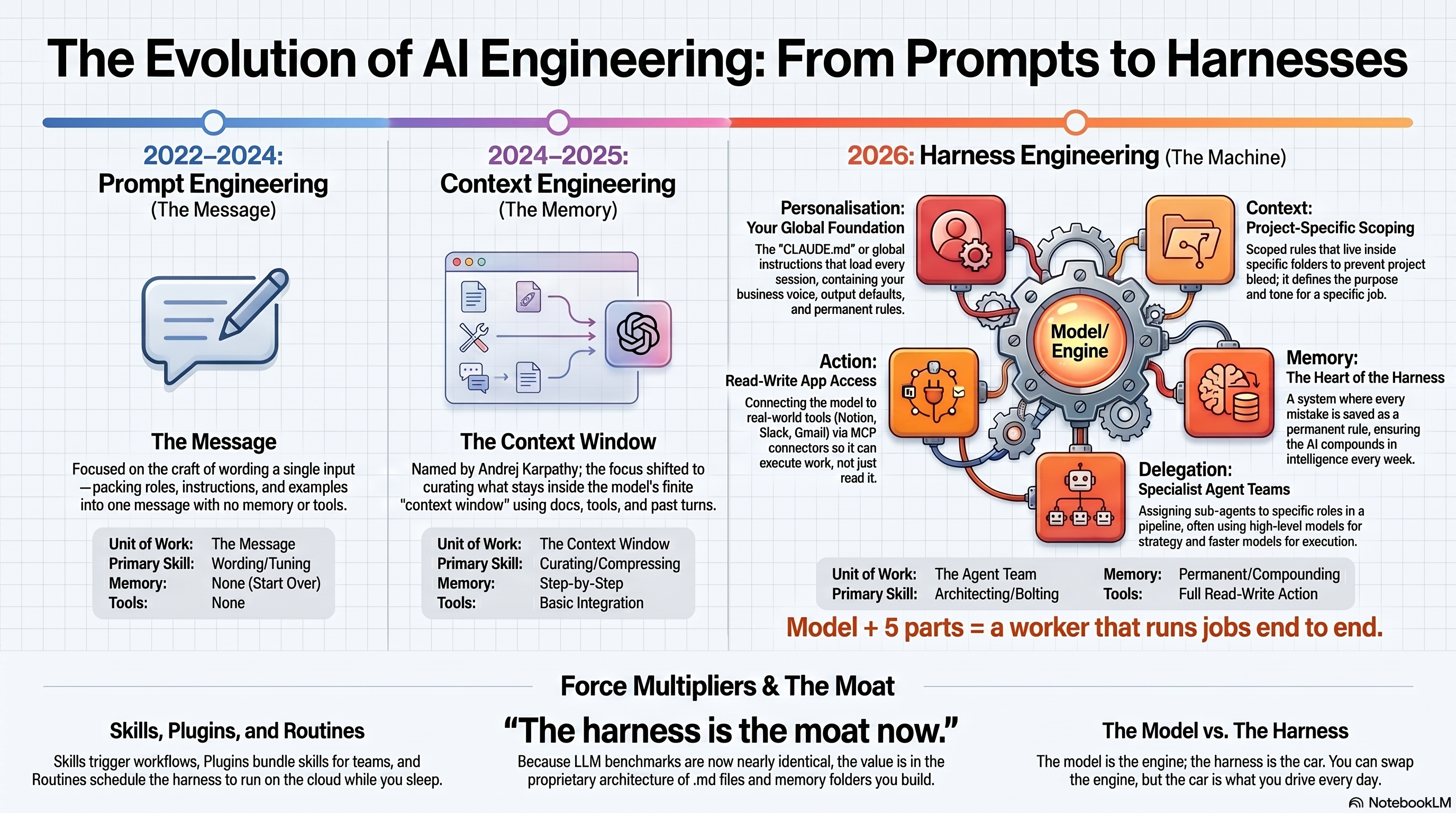
!The Evolution of AI Engineering
The rapid evolution of AI agents demands a sophisticated approach beyond mere prompt engineering. The concept of "Harness Engineering" emerges as a critical framework for transforming basic AI models into robust, autonomous workers. This methodology integrates essential components to elevate an AI's capabilities from a simple chatbot to a highly effective, project-ready assistant.
The journey of optimizing AI interactions has seen several distinct phases, each building upon its predecessor. Understanding this progression highlights the necessity and sophistication of harness engineering.
At its core, an agent harness is the foundational AI model augmented with five essential components. These additions transform a generic AI into a personalized, capable, and autonomous entity.
Implementing an agent harness involves structuring specific files and folders that dictate the AI's behavior and access. This architecture ensures consistency and scalability, whether operating within development environments like Claude Code or collaborative platforms like Cowork.
`CLAUDE.md`: Defines overarching personalization. memory/: Stores global memory and corrections. `skills/`: Contains reusable workflows. commands/: Dictates slash commands for quick actions. * agents/: Manages definitions for specialized agents.
`CLAUDE.md`: Specifies project-level context. skills/: Holds project-specific workflows. * memory/: Stores project-specific memory.
`Custom Instructions`: Further personalization for the account. Connectors: Configures access to external applications for 'Action'.
Personalisation is the bedrock of an effective agent harness, establishing the AI's fundamental operational identity. This component dictates how the AI interacts and processes information, reflecting your unique working style.
Harness Engineering represents a critical advancement in AI agent development, moving beyond simple prompts to create intelligent systems capable of autonomous, end-to-end task execution. By systematically integrating personalization, context, action, memory, and delegation, organizations can unlock the full potential of AI as a strategic operational asset.
Get new posts straight to your inbox. No spam.
Related Articles